
Why Choose Merbau Decking for Your Central Coast Property

Look, we work with plenty of timber species, but there’s good reasons why so many Central Coast homeowners keep coming back to Merbau.
The colour alone sets it apart. That rich reddish-brown to dark chocolate tone brings warmth to outdoor spaces in a way lighter timbers just don’t. And here’s the thing – it actually gets better with age. While some materials fade or look worn after a few years, Merbau develops this gorgeous deeper patina that adds character.
But it’s not just about looks. Merbau sits in Class 1 durability rating, which is about as good as it gets for Australian hardwoods. What that means in practical terms? Your deck handles everything our Central Coast weather throws at it. Salt air, summer storms, humidity – Merbau takes it all without rotting, splitting, or breaking down.
The natural oils in Merbau timber give it serious protection against termites and decay. We’ve seen Merbau decks that are 20, 30 years old still going strong. Try getting that longevity from cheaper options.
Maintenance is surprisingly minimal too. Sure, you’ll want to give it some attention in the first year (we’ll talk about that tannin thing later), but after that? An occasional clean and oil every couple years keeps it looking fantastic. No constant staining, no replacing boards every few seasons.
The grain patterns in Merbau are naturally beautiful – you get variation across boards that creates visual interest without trying. And when you’re looking at premium hardwood options, Merbau delivers exceptional value. You’re getting top-tier performance without paying imported exotic timber prices.

Understanding Merbau Timber Characteristics
Before we start any Merbau deck construction, we make sure clients understand what they’re getting. Not because there’s anything wrong with it – quite the opposite. But Merbau behaves differently than pine or treated timber, and knowing what to expect means no surprises down the track.
The Hardness Factor
Merbau rates around 8.5 on the Janka hardness scale. To put that in perspective, that’s harder than most eucalyptus species. This density is what gives Merbau its incredible durability, but it also means you can’t just whack a nail through it. Every fastener needs pre-drilling, every cut needs sharp blades. It’s proper hardwood work.
Natural Oils and Tannins
Here’s where Merbau gets interesting. The timber contains natural oils and tannins that protect it from insects and decay. Brilliant for longevity, but these tannins will leach out during the first wet season. You’ll see brownish streaks running off the deck – completely normal, nothing’s wrong. Usually settles down within 6-12 months. We always warn clients about this because otherwise they panic when it rains.
Colour Evolution
Fresh Merbau arrives in shades of reddish-brown to yellowish-brown. Expose it to UV and weather, and it darkens beautifully over the first year. Some boards start lighter, some darker – that’s the natural variation that makes Merbau decks interesting to look at. Eventually, if you don’t oil it, Merbau will silver off like most hardwoods. Some people love that aged look, others prefer keeping the rich tones with regular oiling.
Weight and Structure
Merbau is heavy. Properly heavy. Around 900kg per cubic meter when seasoned. Your substructure needs to account for this – we’re not building for lightweight composite here. The weight also means excellent dimensional stability once it’s acclimatised, but you need the right framework underneath.
Sustainability Considerations
Most Merbau now comes from Indonesian plantations rather than old-growth forests. We source from suppliers who provide documentation, but it’s worth asking about if sustainability matters to you. Plantation Merbau performs just as well as old-growth for deck applications.
Our Professional Merbau Construction Process
Building with Merbau isn’t like throwing up a pine deck. This timber demands respect and proper technique, otherwise you end up with problems that shouldn’t exist.
Timber Selection and Preparation
We handpick every Merbau board that goes into your deck. Sounds excessive, but hardwood varies – some pieces have more character, some have tighter grain. We sort through to match boards appropriately and check for any defects that might cause issues later.
Then comes acclimatisation. Merbau needs time to adjust to Central Coast conditions before installation. We store timber on-site for at least a week, letting it stabilise to local humidity and temperature. Skip this step and you’ll get movement after installation. We learned that lesson the hard way years ago.
The Pre-Drilling Requirement
Every single fastener hole gets pre-drilled. No exceptions. Try to drive a screw straight into Merbau and you’ll either snap the screw or split the timber. We use specific drill bits sized for the fasteners, and we drill pilot holes even for the substructure connections. Takes longer, costs more in labour, but it’s the only way to do it properly.
Stainless Steel Everything
Here’s something that catches people out – you cannot use galvanised fasteners with Merbau. The tannins react with galvanising and create ugly black staining that won’t come out. We use 316 marine-grade stainless steel for all fixings. More expensive? Yes. Worth it to avoid permanent stains on your beautiful hardwood? Absolutely.
Spacing and Expansion
Merbau moves less than softer timbers, but it still moves. We leave appropriate gaps between boards – usually 4-5mm – for expansion and drainage. In our humid coastal environment, this spacing prevents boards pushing against each other during wet periods.
Substructure Engineering
Supporting heavy hardwood requires serious substructure. We typically use hardwood or treated pine joists at closer spacing than you’d use for lighter decking. The framework needs to handle the weight without flexing, and we seal all cut ends with quality sealer to prevent moisture wicking into exposed end grain.
Merbau Performance in Central Coast Conditions
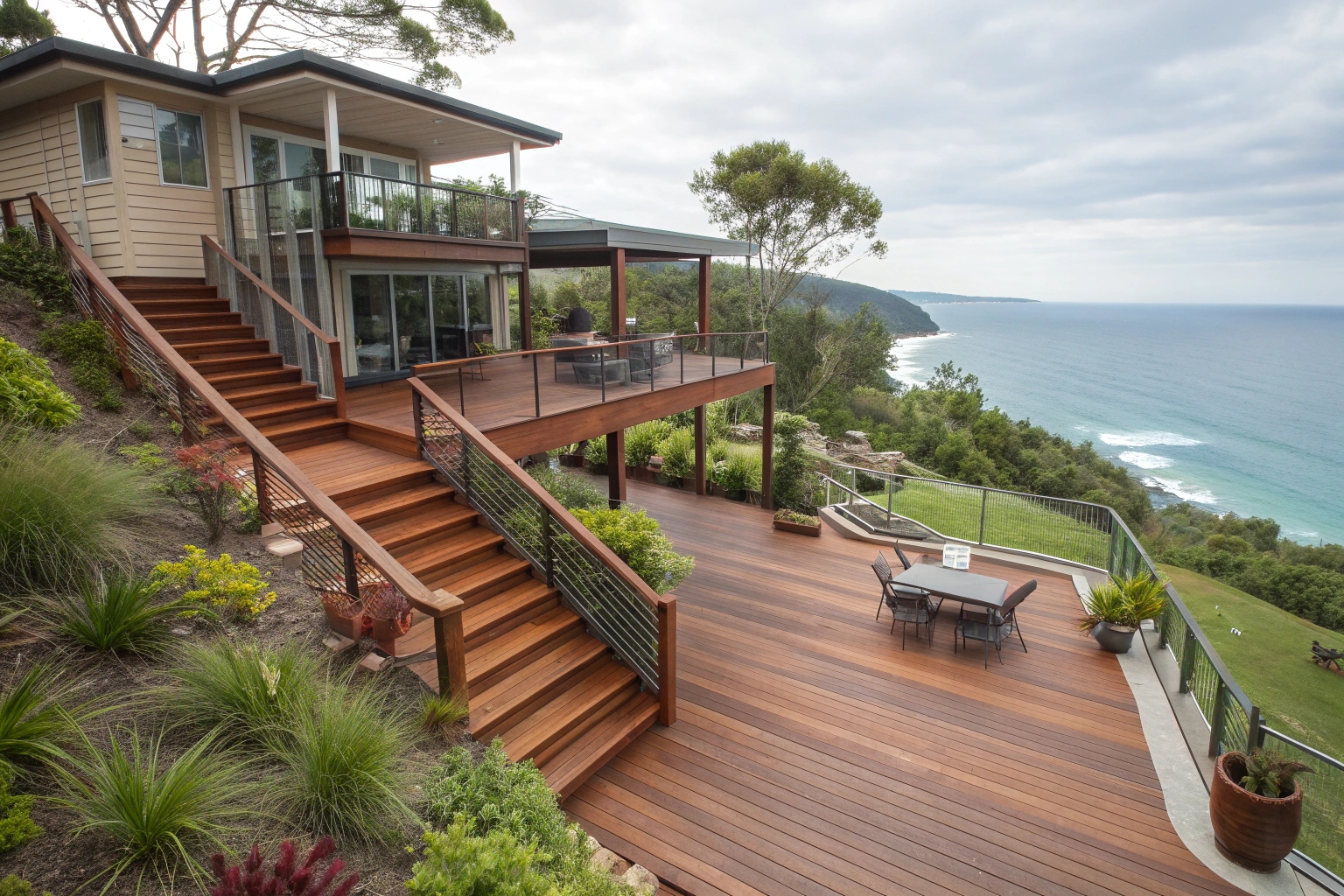
We’ve built decks across the Central Coast for years now, and Merbau consistently proves itself in our specific environment.
The salt air that eats through so many materials? Merbau handles it without issues. That natural density and oil content creates a barrier that coastal conditions can’t penetrate. We’ve got Merbau decks in Terrigal, right near the water, that are 15 years old and still structurally perfect.
Humidity doesn’t faze it either. Central Coast gets humid – properly humid during summer – and plenty of timber species struggle with that moisture. Merbau’s stability means minimal cupping, twisting, or warping even through our wettest periods.
The UV exposure we get here is intense. Summer sun beats down on decks relentlessly. While Merbau will darken and eventually silver without treatment, it doesn’t degrade structurally from sun exposure like softer timbers can. The hardness protects it.
What really sets Merbau apart for coastal properties is longevity. You’re not replacing boards every five years. You’re not dealing with rot or decay from our moisture levels. Install it properly with appropriate fixings and substructure, and you’re looking at decades of performance.
For Central Coast homeowners investing in outdoor living spaces, Merbau delivers that perfect combination – beautiful appearance, genuine durability, and proven performance in exactly our conditions.

Frequently Asked Questions About Merbau Decking
Properly installed and maintained, you’re looking at 30-40 years, sometimes longer. We’ve seen Merbau decks from the 80s still going strong. The Class 1 durability rating isn’t marketing talk – this timber genuinely lasts.
No. The brown streaks from tannin leaching wash away once the process finishes. They might temporarily stain concrete or render underneath, but these clean up. We recommend hosing down surrounding areas during the first wet season to prevent buildup.
Definitely not. Galvanised or zinc-coated fasteners react with Merbau’s tannins and create permanent black staining. You need stainless steel – preferably 316 marine grade. It costs more, but there’s no alternative if you want your deck looking right.
Less than most people expect. After the first year’s tannin phase, an oil treatment every 12-18 months keeps the colour rich. Or leave it untreated and let it silver naturally – still performs perfectly, just looks different. Either way, it’s minimal work compared to softwood decking.
Fresh Merbau has reasonable grip, but like any smooth hardwood, it gets slippery when wet. We can profile the surface or apply non-slip treatments if this concerns you. Most clients find it manageable, especially once the timber weathers a bit and develops some texture.
Honestly, it varies based on site access, design complexity, and current timber pricing. Merbau sits in the premium range but below exotic imports. We provide detailed quotes after assessing your specific project – no point guessing numbers that might be completely wrong for your situation.
Ready to Build Your Merbau Deck?
We’ve been constructing Merbau decks across the Central Coast long enough to know what works and what doesn’t. Every project gets the same attention – proper timber selection, correct installation techniques, and the quality fixings that Merbau demands.
If you’re considering Merbau for your outdoor space, let’s talk about your specific property. We’ll come out, assess your site, discuss design options, and provide a detailed quote that covers everything. No surprises, no hidden costs.
We also keep Merbau samples at our workshop. Seeing and feeling the timber in person makes a real difference – photos don’t capture that rich colour and grain properly. You’re welcome to drop by and check out the quality before making any decisions.
Contact us today for your free Merbau deck consultation and quote.
Phone: 0240036404
Email: info@deckingcentralcoast.com.au
Servicing: Terrigal, Avoca Beach, Copacabana, and surrounding Central Coast areas
We’ll get back to you within 24 hours with available times for a site visit. Let’s build you a deck that’ll still look fantastic in 30 years.
